One Last PAX Experience

I hit PAX on Friday and Saturday, so I should post my notes before they become irrelevant…  It was my first PAX, although I’ve been to many similar con-type events in the past.

General show:

  • With its unabashed “nerdcore” attendee list, PAX is better described as a mini-GenCon than a mini-E3. They have an impressive size for being a fairly young show, but it still is very much centered around fandom of the Penny Arcade comic. The sessions with the authors and on the PA game were some of the hottest tickets, as opposed to other sessions talking about more “serious” topics of development.  Not surprising, it’s not supposed to be a GDC or anything, despite heady topics about PR and episodic content.
  • On the upside, it actually had a fairly impressive turnout of games in playable form, including many that I hadn’t seen before in any form. I assume that falling at the same time as Leipzig gave the publishers some ready-made material to show.
  • Aside from what I mention below, there was a great spread of playable games:  Haze, Eye of Judgment, Metroid Prime 2, Conan (console), Heavenly Sword (a new demo), Warhammer Online, a big America’s Army thing, and several dozen more I’m not thinking of here.
  • Nintendo, Microsoft, Sony and EA all made an appearance, which is impressive given recent news that E for All won’t have that sort of backing.
  • Overall PAX surprised me with an air of “legitimacy” as a serious show. It would take a couple more years, but if it ultimately balloons into a notable national event, it’ll be cool for Seattle. Continue reading One Last PAX Experience

PAX Day Friday!

Surreal sent the entire company to PAX (the Penny Arcade Expo) on Friday…  It was conveniently located in downtown Seattle this year, at the Washington State Convention Center, not too far away.  A few of us actually found a reason to take the semi-famous-but-usually-useless Seattle Monorail (it only travels end-to-end from the Space Needle to downtown, not very far).  The rest of us found that it wasn’t that far of a walk… and we were able to stop at Shorty’s for a dog in the process!

Some of the guys have some impressions that will be posted shortly.

Refueling in Room 130

I should talk a bit about my experiences with the academic group that made up Joystick101 and the local groups around it.  As I reached 2004 and was just finishing up X-Men Legends, I was getting pretty burned out on the industry…  11 years of making varieties of shooters at Raven was entertaining, but was growing into a somewhat single-note affair.  Around then, Nathan McKenzie, an incredible gameplay programmer I had been fortunate to poach from a college back in (I think) 1996 was acquainted with a lot of the game academics around the University of Wisconsin.  After an awesome run completing Soldier of Fortune in 2000, Nathan had taken a couple of years off and did something of a journey of self-discovery…  He came back to work on Quake 4 in (I think) 2003 with a lot of academic knowledge and a pretty unique view on games. 

Anyway, Nathan introduced me to the UW academics that had been studying games…  something I had no idea existed.  They were an incredibly interesting group, including Kurt Squire, Constance Steinkeuhler, Alice Robison and notably Professor Jim Gee.  Every week a group of them, including a number of other graduate students in departments such as Education, Linguistics and English, would gather in a game wonderland known as Room 130.  Every week these folks would gather and play a new game, observe and talk about them.  These were not the hardcore gamers that I had grown accustomed to interacting with, although they loved games with an equal fervor.

 Coming from a fairly practical point of view on games and development over the previous 11 years, I felt refreshed.  I didn’t ultimately “switch” to an academic perspective as much as Nathan did (he’s doing awesome, more power to him!), but my eyes opened a bit, knowing that there were more angles to look at games than I had realized…  Not everyone was searching for that 20-levels-8-weapons-12-enemies magic formula that seemed so common out there.  It was just what I needed to help me explore other genres and places. 

So, to the Room 130 folk, my thanks.

Making the Rules: Great Enemies

complicated_flowchartPreviously I’ve talked about how games adjust AI difficulty because of the need to fulfill the player’s fantasy, and provide them with success and positive feedback. This time I’d like to talk about perils and pointers for creating good combat AI. Now, while many articles that wish to address “great AI” contain heavy jargon or equations and diagrams depicting line of sight, or reticular splines or some such, let’s put that aside for now. It can be a great deal simpler than that (although in some ways more challenging).

Out of Sight, Out of Mind

Imagine dropping a player in a sprawling maze… hedgerow, factory, prison, whatever… that is impossible to be known beforehand. Within there is one incredibly realistic, human-like AI… It operates on its senses, with no unfair information about the maze or the player, but it executes on some crazy supercomputer with a million factors that it takes into account, from its knowledge of combat tactics to its own preferences and personality. Hell, let’s even keep track of what it had for breakfast in case we want to simulate a chance of it having an upset stomach. This AI’s job is to start searching for the player and make assaults as he moves through the maze. For a moment, as we watch the AI, we can see it moving through the maze, tracking the player’s scent, thinking about how to flank him… when it hits a fork in the path, it decides to go left or right based on tactical decisions, or its own tendencies, or whatever a human-like AI should do. Perhaps it has a human-like idiosyncrasy like alternating… Whatever. The important thing is when it finds the player, whether by crafty wiles or just dumb luck, it switches to combat tactics and starts attacking the player without warning, pressing any advantage it can. When it is out of the player’s view, he is completely stealthy, undetectable until he encounters the player again.

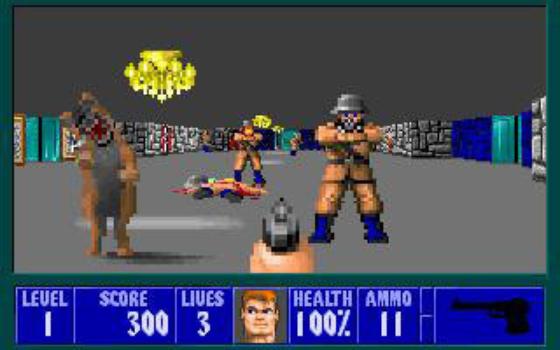
Wolf3dNow imagine this experience from the player’s perspective. He’s moving through the maze, starting to get familiar with his surroundings. Assuming the brilliant AI is quiet like he is, the enemy could be around any corner. The first time he encounters him, the attack could be anywhere, behind, ahead… who knows. If the AI is particularly crafty and sets up a sniper ambush, the player could die in a single shot to the head. To the player it’s a chaotic, unpredictable experience… Perhaps a fun one for some, perhaps not.

Now let’s replace the AI with a more rudimentary version, one that makes more random decisions about what path to take while moving through the maze. This is sporadically punctuated with the AI taking the best path to the player, using perfect information. The enemy will still use intelligent tactical decisions once the player has engaged it in combat, but when it is out of the player’s sight, the AI is entirely artificial. For the player, assuming the general frequency and predictability of the enemy appearance is similar, very few audience members will notice the difference.

Now let’s go even further, and replace the AI with a spawning routine that creates an enemy at the edge of the player’s awareness at a similar frequency and predictability as either of the other approaches. Certainly there are a few cases where it would make a wrong choice, such as spawning the enemy from a dead-end, but how often would this become apparent to most players? .

Now what point am I making here? That “real AI” is worthless? Of course not! When the enemy is within the player’s view, it needs to act extremely effectively, to provide the player with sufficient combat challenge and to keep the illusion up that this is human-like behavior. However, once the player has lost all perception of the enemy’s movements, there is a significant drop-off in the impact of sophisticated AI on the player’s game experience… That enemy could go off and play chess, consult his favorite tracker’s handbook or compose humorous limericks about the death of the player, but none of it makes much of a difference if the player is not aware of these activities. And it doesn’t advocate delivering “good enough”, it’s just that we could be using that supercomputer for better things.

A Pinch of Player Feedback

Soldier of Fortune 2-1Of course there are better ways of selling an interesting “hunt” scenario between a player and an AI. The game might have remote cameras out in the world that allow you to sporadically see his activities. The enemy can leave a trail that you can pick up. He can make noises that might give away their position or distract you. These additions almost universally add additional player awareness of the AI’s activities when he is out of sight.

Sure, you can add some clever AI tactics that go beyond spawning… he might feint in one direction to lure you off, then work around and flank you. However, consider that we are adding to events in a chaotic, confusing combat situation to begin with. How would most players feel if they went towards an enemy who disappeared, appearing not much later to shoot him in the back? He might feel confused, or cheated, like the AI did something illegal. There is no satisfaction to be gained by guessing the enemy’s next action and planning accordingly. There is no learning process to “outwit” the opponent, nor is there any way to increase one’s skill to defeat him, aside from simple reflex improvement such as firing a gun accurately.

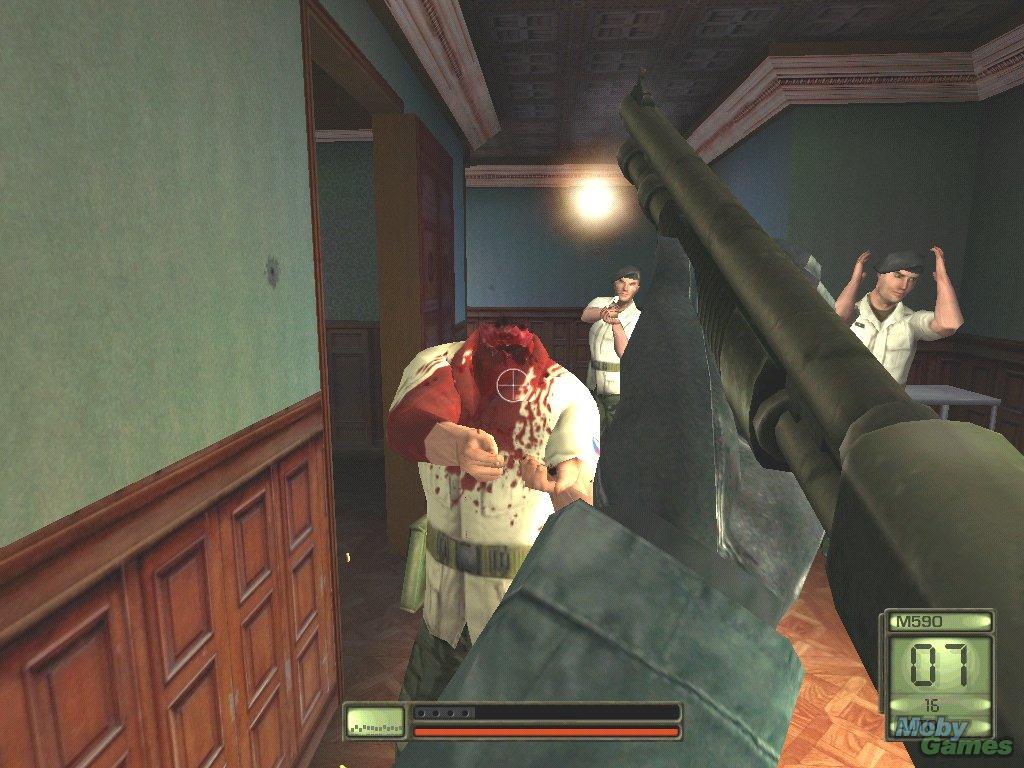
The development of most game features require the creator to balance of the investment of time and computer performance, versus the gameplay value created. No feature is free, and in a shooter, if the AI programmer spent all their time creating AI’s that can independently recreate all the works of Shakespeare, the time would generally be wasted… such effort and horsepower doesn’t help the player… this is a game about combating the enemy. Back when I was working on Soldier of Fortune 2, there were some enemies that had the ability of tossing clips to each other if one ran out of ammo. However, nobody knew that feature existed. Why? Well, the clips were never exchanged unless the two enemies were behind cover, completely out of sight. Also, the ammo level of any individual enemy was never a significant issue in the game, since fights tended to be very short and deadly. This was a time to invoke a cardinal rule of game development: Features that do not notably affect the player experience are usually not worth implementing.

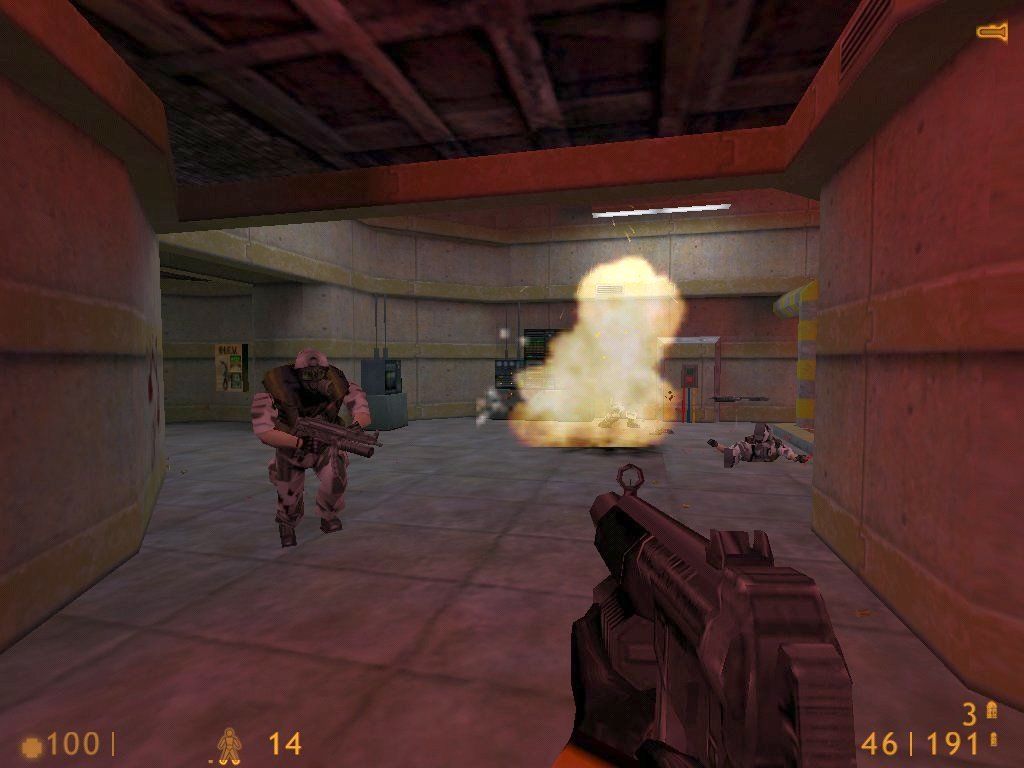
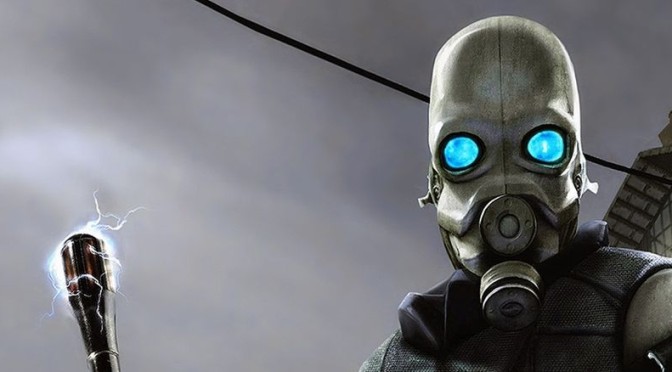
Half Life 1Contrast that to the AI in the first Half-Life, which critics and consumers unanimously celebrated as one of the most significant contributors to their enjoyment of the game. In Half-Life the enemies did all sorts of things, from flanking you to spotting your thrown grenades and responding accordingly. However, combat against the deadly Black Mesa soldiers was a very hide-and-shoot affair, so there would have been little opportunity for the player to understand their tactics and smarts. However, some exceedingly smart individual at Valve decided to give the player a radio that intercepted the soldier’s communications, which gave the player a window on their reactions and strategies. Sure, it would have been even more challenging for the player if he had absolutely no clue to what the enemies were going to do next, but it is far more impactful to the player’s experience to allow him to understand how smart the enemies are. Arguably, beyond every other feature the enemies in Half Life had, the radio was the single most significant invention of that game.

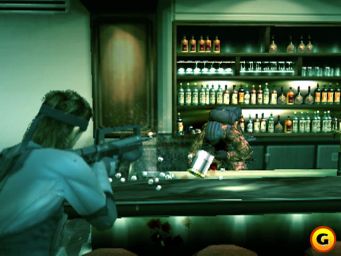
Enemy communication of their intent has been used in other games, such as Halo, where the slightly comical alien grunts would spout exclamations like “there he is!” or “where’d he go?” when they observed a specific situation. Metal Gear Solid soldiers talk to themselves, saying “what was that noise?” and so on. Of course it’s not realistic, but it makes things more fun. Concealing those mechanisms actually creates a less compelling experience than when you lay out the rotating gears in front of a big window that the player can see.

Great AI lives in the player

mgs2iceSo if a more human-like opponent leads to unpredictable, and often unsatisfying behavior, and realistic, limited information plunges the player into a chaotic, random-seeming experience, what is the player asking for when he or she is asking for “better AI” or a “smarter” opponent? The answer to this harkens back to a previous point, that the player wishes to fulfill a specific fantasy that they have. They wish for their opponents to respond as they imagine they would in their fantasy. In the case of a super-spy fighting against armies of henchmen, it’s a set of opponents that appear to fight against the player effectively, yet die or fail to kill the player at appropriate moments so that the player can feel powerful.

In a player’s fantasy, an enemy is still capable of many things. There is a great deal that a gamer can imagine his electronic opponents doing to try to outsmart him. This includes flanking the player, hearing noises and investigating, changing ammo types, and spotting and responding to thrown grenades. In fact, it could be said that a large variety of actions at the enemy’s disposal is what might make him seem “smart”. However, again, with limited information confounding the player’s ability to appreciate this rich palette of AI options, there is but one avenue to make a character seem intelligent… we must inform the player of some of the choices that are being made while they are being made, so that the player can feel even cooler when taking them out.

Archive 3: Hail to the Prince

This was the second article I wrote for Joystick101 in Spring 2004… Sadly enough, around that time, the site was pretty much dying on the vine. It tended to be down a lot. Since blogs and blog sites weren’t really too common yet, this was the only outlet for this content, so my participation in that forum pretty much died with the site. Again, when it was resurrected in 2007 it was relaunched with a WordPress backbone and the old content and community was reset.

Play Appraisal: Observations of a Developer
By Patrick Lipo
March 2004

Hail to the Prince:

When I heard about the development of the most recent sequel to Prince of Persia (PoP: The Sands of Time), I along with many others indulged in skepticism. I loved the original and really enjoyed the second one, and look back at them as the absolute best in action-exploration. I do recognize some of this feeling as nostalgia, however, since they were also excellent examples of gameplay that was common 15 years ago… a 2D world filled with death-defying jumps and quick, easy deaths. Having tried the third title in the series, PoP 3D, it was easy to think of that game’s limitations as evidence that the series could not be updated to a modern 3D presentation without losing its spirit. That third title unfortunately had a very difficult time with establishing a working control scheme and camera, but in addition it focused on giving the player more choices and weapons for fighting (as a gamer might expect in one of today’s games), rather than considering PoP’s pedigree as a game of exploration.

When considering the difficulties that PoP 3D had, I cannot help but appreciate the core elements of the original’s design, and how bringing them to today’s game-playing audience would be quite difficult. For those that have not played the original Prince of Persia, it was a side-view exploration game, where your character progressed through various screens and overcame a variety of death traps in order to continue. It was a fairly brutal game, with sparse checkpoints and unforgiving traps that had to be overcome, including long falls, spring-loaded spikes, slashing blades, collapsing floors, and other instruments of serious peril. While the player did have a health bar to absorb damage from short falls and the occasional swordfight, running afoul of a trap generally meant instant, gory death.

Rube Goldberg:

While it is easy to categorize the Prince of Persia games as exploration mixed with sword-fighting and jumping challenges, after a period of time playing, you find an unexpected game buried within. For example, while some platformers rely on split-second timing and twitch abilities to accomplish their most advanced moves, each of the Prince’s leaps, crawls and dashes are fairly easy to accomplish. In fact, the famous wall-run created for PoP: Sands of Time is so forgiving that it almost feels as though the hero is guided along a track. It and most other of PoP’s moves (most notably in Sands of Time) are actually difficult to do incorrectly assuming you chose the correct time to use that move. Some hardcore gamers bash Sands of Time for that reason, stating that the game strays too close to playing itself rather than providing the player with sufficient challenge. To dismiss the game for that purpose is to miss an important aspect: Once the player has a general understanding of the moves and the obstacles that each move is capable of overcoming, the game becomes as much of a relationship with the classic game The Incredible Machine as Super Mario 64.

In The Incredible Machine, the player is given a set of pieces that each exhibit a certain behavior and accomplish a task by applying them to the level’s game board. In Prince of Persia, the player is trained to use a library of moves that can be used as tools to bypass obstacles, after which he is challenged to accomplish a task (typically reaching the exit) by applying them to the presented environment. In addition, the presentation of Prince of Persia has two other elements that are required to allow the player to approach an area as an intellectual challenge rather than a test of reflexes. The first element is that the player has a clear set of predictable properties that he can draw from. This is his “toolkit,” as it were, that he can draw upon to complete a given level (while Sands of Time was admirably seamless, each area was definitely presented as a stage or level to overcome). The Incredible Machine had easy-to-understand physical devices such as treadmills and rolling balls, whereas PoP draws from a set of very predictable moves. The “forgiving” nature of the wall-run that puts off the hardcore player suddenly becomes an asset because the player can look at a wall and immediately know whether he can clear that space with the move. The challenge, then, was not in executing the wall-run flawlessly, but rather figuring out when to use it.

The second element that makes Prince of Persia playable as a puzzle game is its ability to present the player with a clear view of the level for planning purposes. The original 2D versions could easily present “the game board” in this respect, as the viewpoint revealed all elements to the player. Nothing was hidden completely… even the collapsing floors in the original PoP could easily be revealed with a quick jump in-place. This gives the player the ability to plan and mentally execute the solution before committing his hero to it. In taking this formula to 3D, Sands of Time provided very grand, open-aired spaces for the hero to navigate. This had a fabulous impact in presentation, giving the feeling of very large spaces, and locations so high that a real sense of vertigo can be experienced. In addition however, it also provided a clear view of the elements that would be navigated, going so far as to provide a specially-placed camera that the player could always switch to in order to see the challenges ahead of him. Since the player was able to plot his route, if he were to die, it was always clear that it was due to some flaw in deduction rather than an arbitrary timing mistake or unfair “gotcha”.

A Ticking Clock:

Binding this puzzle-oriented gameplay together in the original Prince of Persia was an unusual method of limiting the player’s deaths. Instead of a set number of lives, the player is given exactly one hour to complete the entire game. Being killed simply meant some time lost from retracing one’s steps from the last checkpoint. This gives the game some urgency but also presents a tangible but relatively small penalty for taking risks. This penalty, however, grows naturally as the player progresses towards the end, since the amount of remaining time is constantly dwindling. The player will of course run out the clock many times over before he can even come close to the end of the game, but with each attempt he will improve his speed, and reap a quantifiable reward from increased prowess (additional seconds on the clock when starting each level). And naturally, as less time is spent in the early levels, the comfort zone where the player feels at ease with experimentation migrates into later areas of the game.

In addition, time in the game becomes a resource that the player wields with complete control. The player comes to understand that each time he fails the overall mission (runs out of time) it was due to his own actions and his general performance while playing the game. Conversely, as he improves, he saves time and gains security. Of course, once the game has been completed (within the allotted hour), the next challenge for the player is to complete the game in as short a period as possible. Since the hero starts out with very few health points and can only gain more by finding hidden potions, the best way to do get a low time score is to ignore the health-increasing potions and attempt to complete the game without the benefit of the extra health. The increased health mainly serves to give the player an advantage while swordfighting, so by leaving his health low, he must also put his faith in his fighting capabilities as well.

These aspects of Prince of Persia provide an intriguing meta-challenge to the player’s experience. Not only does he compete with the traps within the game, but he must look at a game session as a whole and determine how each early decision will affect the clock situation later on. He must also make decisions as to how much assistance he needs to complete the game without dying, rather than to take every gift offered him. The high-level “game” that continues in the player’s mind through multiple sessions of play is a puzzle all its own.

Let’s Do The Time Warp Again:

The choice to put a ticking clock in the original PoP added an excellent high-level playing experience, but when thinking about how it would be updated for the modern console audience, one must consider how it was built on an old-school approach to game challenges. The hero is quite vulnerable, and the player must endure multiple abrupt deaths as well as play through areas repeatedly after having to continue from a checkpoint. This sort of repetition and the inability to save games was familiar to gamers of the eighties and early nineties, but I am skeptical that this sort of approach would be accepted by the more casual gamers of today. However, to “fix” Prince of Persia by implementing infinite saves and higher character survivability could easily have destroyed the game completely. The very nature of death-defying jumps requires instilling fear and the risk of some sort of penalty. If there is no significant downside to poor performance, the player could become encouraged to blindly stumble through the challenges rather than to take a moment and plan his approach. Bringing in the timer from the original would have had its own raft of problems as well… The requirement of starting over from the beginning of the game repeatedly to make progress would probably have been seen as an extremely outdated mechanic and could have quickly driven away players. And to be fair (since I don’t consider modern players to be less worthy in any way), being stripped of one’s achievements again and again can truly feel frustratingly harsh.

In updating the series, The Sands of Time removed the meta-challenge of the time limit and relied on the more traditional approach of checkpoints and save games. This act brought the PoP series into a progression framework that fits modern players’ expectations, which was probably a wise choice. However, it still needed to address the issue of character mortality, which I would contend was necessary for the game to function as a puzzle game. With such deadly traps, the game could easily have become incredibly frustrating to play. Loading one’s savegame again and again would have been necessary to complete a difficult challenge (or to experiment with possible solutions to a level’s “puzzle”). The designers of Sands of Time, knowingly or unknowingly, were in a very difficult position. Either the game could retain its purity and risk being considered too hardcore, or it could have become too forgiving and transformed from a puzzle game to an action game. It is at this point that its predecessor, PoP 3D, most likely faltered.

The choice that was made for PoP: The Sands of Time to address this was an amazingly innovative one. In the final game, a limited resource of sand gives the player the power to rewind time at any moment, allowing him to retry any misstep. Essentially, it takes the player’s act of loading a savegame (which can be considered a “feature” that allows a player to retry any section of the game) and folds it into the game mechanics itself, going so far as to dedicate a controller button to that function. In most other games, when a player is forced to load a savegame repeatedly, the overall experience is diminished. In Sands of Time, the sand is a resource that is acquired through continuous adventuring, so the game becomes richer when players are forced to use it to retry a challenge. The interesting result of this strategy is that since the player is rarely forced to return to a save point, the game can present extremely difficult challenges while avoiding the seemingly inevitable frustration. Even more intriguing, the mechanic allows the player to almost continually experience new things and overcome new challenges, rather than retracing the same steps taken many times before. This choice may have taken a decidedly hardcore game type, an old-school platform-jumping title and restored its viability.

Crossing Swords:

While the Prince of Persia series has always had swordfighting, it would be foolish to think of fighting as the primary element (excluding PoP 3D, which focused a great deal on combat). In the original Prince of Persia, the guards blocking the hero’s way often acted as yet another puzzle piece… There were times when an opponent had to be dispatched in a certain way because he was located so he could kill the hero outright before he could draw his sword. However, in The Sands of Time, the fighting is more or less a pure interlude. This provides spikes in the game’s pacing but also simply sells it as a cinematic Arabian adventure. Luckily in SoT, the fights contained a few simple behaviors that provided a reasonably different experience than a typical brawling game.

The enemies in PoP: The Sands of Time are essentially undead, which means that they will always rise after each knockdown, until the player can reach a downed opponent and strike the killing blow with his dagger (which takes a short amount of time). The challenge of the combat then becomes buying time with repeated knockdowns, and trying to separate a specific enemy from the pack so that he can be dispatched without the player being interrupted by other enemies. The tactics then rely on the hero being very mobile, keeping away from the pack of enemies until he is able to dart in and strike at an individual. This mobility-centric behavior builds on the game’s technical strengths beautifully, since the game is very impressive when the hero is moving about, completing dodges, flips and rolls.

Conclusions:

  • The traps in Prince of Persia each have moves that can overcome them easily, but the real challenge is to deduce the series of moves that it will take to accomplish an entire area, akin to a puzzle game.
  • The overarching timer in the original Prince of Persia provided urgency, yet allowed the player to experiment heavily in the early game without significant penalty.
  • Allowing the player to get an even higher score (e.g. a lower time) by avoiding powerups allowed the player to choose their own risk and confidence level.
  • The time-rewind feature of Prince of Persia: The Sands of Time allows a very unforgiving set of traps to be viable in design.
  • Time-rewind more importantly means that the player can always be working on something new, rather than retracing steps time and time again.
  • The predictability and forgiving feel of the special moves serve a purpose of allowing the player to focus on deducing the moves rather than executing them.
  • The combat in Prince of Persia is simple, but in Sands of Time, the simple addition of a killing move allowed the fighting to become more about motion and looking cool than a single fight.

Playing through Prince of Persia: The Sands of Time recently taught me a fair amount. By looking back at the decisions the designers made, and examining how an older style of challenge was brought into a modern game, it allowed me to look back and understand how I experienced the series as a whole. The result is a series of conclusions that I hope will enrich how I look at other games as well.

Frantic, Fearless and Fun

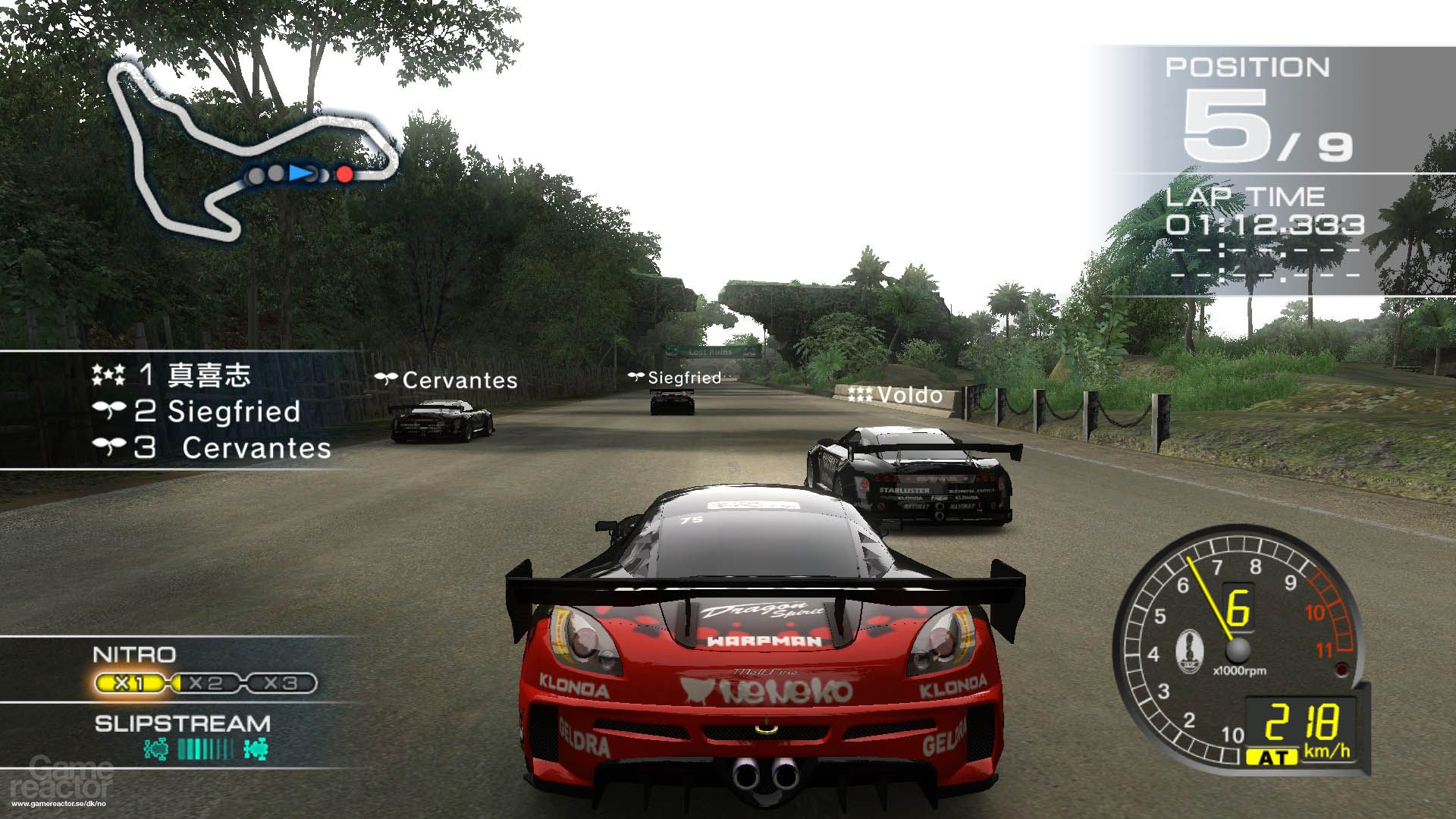
Ridge Racer 7I picked up a PS3 the other day and still have yet to purchase a retail game for it…  Aside from staring at the crossbar and wishing I had a Blu-Ray movie to watch, I’ve spent much of my PS3 time playing demos.  After whipping through miniature slices of Motorstorm, The Darkness and even my coveted Heavenly Sword, I was still a bit bored.

Just for kicks, and because I was running out of diversions, I threw Ridge Racer 7 into my download basket.  God, I mut have been desperate…  That game hadn’t changed in like a million years.  I used to love RR, having played the hell out of the very first one on the Playstation, holed up in the basement offices during the early days of Raven Software.  However, other interests took my attention, so I hadn’t really played one seriously since R4, the last of the PS1 incarnations.

However, the moment I fired up RR7 and hit the accelerator, it was like coming home.

I raced around the track, not knowing the layout at all or the new mechanics like nitro boost and drafting.  However, I happily whipped around the corners like a madman and never even touchedthe rail.  I felt like a racing god for just a moment.  Holy crap!  After playing other (somewhat) realistic racers for a while like Gran Turismo and Forza, it felt incredibly liberating to just keep that accelerator down and try to skid around by the seat of my pants.  I don’t like to drive strategically, where I have to manage speed like a precious resource, I like to drive stupid fast and have to rely only on my wits to carry the day.  Obviously Burnout is the only other game that scratches that itch in the same way.

Sure, it’s not real racing, but it’s fun.

This got me thinking about other playing habits I exhibit.  For example, when it comes to shooters, from Doom all the way to this test build of Stranglehold I’ve got on my desk, I tend to really enjoy situations where I can head into danger, balls-out, and manage the situation on the fly.  Back in the Doom days, I got insanely good at shotgunning soldiers and imps, after leaping into rooms teeming with them and just barely manage to destroy each one as they lunged at my digital throat.  (I somehow did this playing only with a keyboard, somehow).  Does that mean I don’t like strategy, or a game that requires planning or thought?  No, I wouldn’t say that, but when it comes to shooters these days I do tend to lean more towards the Serious Sams of the world than I do the Ghost Recons.

Sure, it’s not real combat, but it’s fun.

To consider this to be a conflict between reflexes and strategic thinking isn’t the whole story.  To me the key is a loss of control, having to dive into danger and not quite know how you’re going to get out.  Assuming the game is forgiving enough and doesn’t punish you for those types of choices, it remains a fun experience.  If you can take the chaos of a situation and “surf it” to where you want to go, it’s a blast.  That’s what Ridge Racer drifting does for me, and sometimes my love for that type of experience leads to certain design choices I make, whether it has to do with driving, combat, or who knows what.